Compare Global.

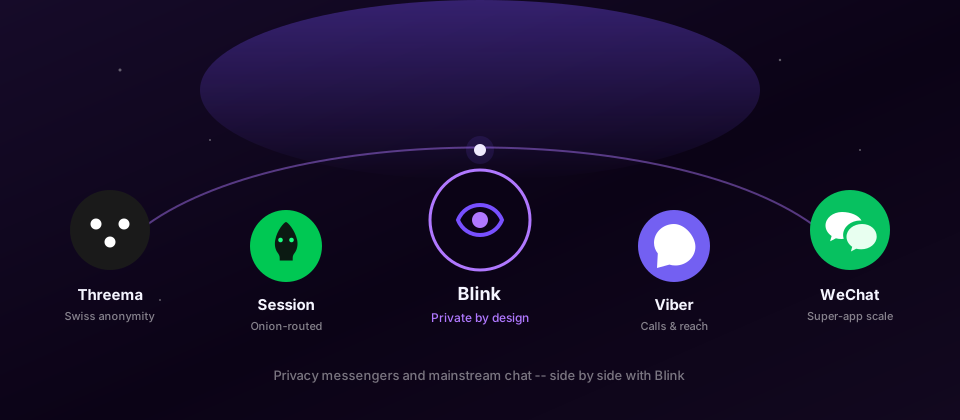
Four messengers. Four threat models. See how Swiss anonymity, onion routing, consumer calling, and China's super-app stack up — and where Blink adds device control those apps leave open.

Blink compared with Threema, Session, Viber, and WeChat

The lineup

Know each app before you brief the team

Privacy-first messengers and mainstream chat solve different jobs. This page is an honest map — not a claim that one app wins every scenario.

Threema logo

Threema

Switzerland

Swiss privacy without a phone number

A paid Swiss messenger that creates a random Threema ID — no phone or email required — with end-to-end encryption for messages, calls, and files by default.

Founded
2012
Pricing
One-time purchase (consumer); Threema Work for orgs
Best for
Individuals and orgs who want Swiss jurisdiction and anonymity
Session logo

Session

Decentralized network (foundation-backed)

Decentralized, onion-routed messaging

A free, open-source messenger that routes traffic through an onion network of service nodes — no phone number, email, or central server that can map who talks to whom.

Founded
2020 (Session)
Pricing
Free
Best for
Users who prioritize metadata resistance and anonymity
Viber logo

Viber

Luxembourg / Rakuten group

Consumer chat with cheap international calls

A Rakuten-owned messenger popular for stickers, communities, and low-cost calling. Chats and calls are end-to-end encrypted by default, but the product collects substantial metadata.

Founded
2010
Pricing
Free (ads / commerce features)
Best for
Friends and families who want calling + stickers at consumer scale
WeChat logo

WeChat

China

China's everyday super-app

Tencent's WeChat combines messaging, payments, Moments, and mini-programs at massive scale. It is built for convenience and ecosystem lock-in — not for confidential or adversarial threat models.

Founded
2011
Pricing
Free (payments & services ecosystem)
Best for
Everyday life and commerce inside the WeChat ecosystem

Side by side

Feature comparison matrix

Capabilities summarized from public product behavior. "Partial" means limits, optional modes, or weaker guarantees. Always verify against each vendor's current docs for your threat model.

Yes Partial No Coming soon

Privacy & identity

End-to-end encryption by default

Message contents sealed so the provider cannot read them in normal operation.

  • BlinkYes
  • ThreemaYes
  • SessionYes
  • ViberYes
  • WeChatNo

Privacy & identity

No phone number required

Account can be created without tying the identity to a mobile number.

  • BlinkYes
  • ThreemaYes
  • SessionYes
  • ViberNo
  • WeChatNo

Privacy & identity

Strong metadata minimization

Designed so the operator learns as little as possible about who talks to whom.

  • BlinkYes
  • ThreemaYes
  • SessionYes
  • ViberNo
  • WeChatNo

Privacy & identity

Privacy-friendly jurisdiction / architecture

Legal or technical design that resists casual surveillance and data fishing.

  • BlinkPartial
  • ThreemaYes
  • SessionYes
  • ViberPartial
  • WeChatNo

Security

Open-source clients (auditable)

Client code published for independent review.

  • BlinkPartial
  • ThreemaYes
  • SessionYes
  • ViberNo
  • WeChatNo

Security

Forward secrecy / key rotation

Compromised keys cannot reopen an unbounded past of messages.

  • BlinkYes
  • ThreemaPartial
  • SessionNo
  • ViberPartial
  • WeChatNo

Security

Decentralized / onion-routed delivery

No single central server holds the full routing graph.

  • BlinkYes
  • ThreemaNo
  • SessionYes
  • ViberNo
  • WeChatNo

Device control

Remote wipe / lost-device revoke

Wipe or invalidate a lost device so it cannot keep reading ciphertext.

  • BlinkYes
  • ThreemaPartial
  • SessionNo
  • ViberPartial
  • WeChatPartial

Device control

Duress / panic wipe

A covert wipe path if the device is seized under coercion.

  • BlinkYes
  • ThreemaNo
  • SessionNo
  • ViberNo
  • WeChatNo

Device control

Anti-keylogger / custom keyboard

Blocks system or third-party keyboards from watching keystrokes.

  • BlinkYes
  • ThreemaNo
  • SessionNo
  • ViberNo
  • WeChatNo

Device control

Screenshot / screen-capture protections

App-level defenses against opportunistic screen capture.

  • BlinkYes
  • ThreemaPartial
  • SessionNo
  • ViberPartial
  • WeChatNo

Features

Voice & video calls

In-app calling for real-time conversations.

  • BlinkYes
  • ThreemaYes
  • SessionPartial
  • ViberYes
  • WeChatYes

Features

Disappearing / ephemeral messages

Time-boxed chats that leave less readable residue.

  • BlinkYes
  • ThreemaYes
  • SessionYes
  • ViberYes
  • WeChatPartial

Features

Encrypted file vault / Secure Locker

Files (and often filenames) sealed outside the chat stream.

  • BlinkYes
  • ThreemaPartial
  • SessionNo
  • ViberNo
  • WeChatNo

Features

Team Spaces / org roles (RBAC)

Isolated workspaces with admin roles for real teams.

  • BlinkYes
  • ThreemaPartial
  • SessionNo
  • ViberPartial
  • WeChatPartial

Platforms & pricing

Cross-platform (mobile + desktop/web)

Usable across phone and computer without losing core guarantees.

  • BlinkYes
  • ThreemaYes
  • SessionYes
  • ViberYes
  • WeChatYes

Deep dive

Complete profiles for each messenger

Blink logo

Blink

Blink

Private by design for high-stakes teams

Ciphertext-only servers, device control, duress wipe, Secure Locker, and multi-tenant Spaces — built for moments when a padlock icon is not enough.

Operator

Blink

HQ

US & India operations

Founded

Pricing

Team / enterprise plans

Platforms

Web, iOS, Android

Privacy fit

High — with device & duress controls

Strengths

  • AES-256-GCM on-device encryption with ECDH P-256 key agreement
  • Anti-keylogger keyboard, screen protection, remote wipe
  • Reverse-PIN duress wipe and Secure Locker
  • Spaces with real RBAC roles

Trade-offs

  • Smaller network than consumer super-apps
  • Some call and camouflage features are badged on the roadmap

Best for: Newsrooms, legal, field & executive teams

Threema logo

Threema

Swiss privacy without a phone number

A paid Swiss messenger that creates a random Threema ID — no phone or email required — with end-to-end encryption for messages, calls, and files by default.

Operator

Threema GmbH

HQ

Switzerland

Founded

2012

Pricing

One-time purchase (consumer); Threema Work for orgs

Platforms

iOS, Android, desktop apps

Privacy fit

Very high — minimal metadata, anonymous ID

Strengths

  • No phone number or email required (Threema ID)
  • E2EE for chats, calls, and files using NaCl / libsodium
  • Open-source clients with regular external audits
  • Messages deleted from servers after delivery; GDPR-aligned Swiss law

Trade-offs

  • Paid upfront (can slow viral adoption)
  • Smaller user base than WhatsApp / WeChat-scale networks
  • Centralized servers (trusted Swiss operator, not decentralized)

Best for: Individuals and orgs who want Swiss jurisdiction and anonymity

Session logo

Session

Decentralized, onion-routed messaging

A free, open-source messenger that routes traffic through an onion network of service nodes — no phone number, email, or central server that can map who talks to whom.

Operator

Session Technology Foundation / Oxen ecosystem

HQ

Decentralized network (foundation-backed)

Founded

2020 (Session)

Pricing

Free

Platforms

iOS, Android, desktop

Privacy fit

Very high on metadata — different trade-offs on delivery

Strengths

  • No phone number, email, or personal identifiers (Session ID)
  • Onion routing hides IP addresses across service nodes
  • E2EE by default via the Session Protocol (libsodium-based)
  • Open-source clients; no central message store to subpoena

Trade-offs

  • Message latency and delivery can vary on a decentralized network
  • Does not offer the same per-message forward secrecy model as Signal
  • Fewer enterprise admin / device-control features than Blink

Best for: Users who prioritize metadata resistance and anonymity

Viber logo

Viber

Consumer chat with cheap international calls

A Rakuten-owned messenger popular for stickers, communities, and low-cost calling. Chats and calls are end-to-end encrypted by default, but the product collects substantial metadata.

Operator

Rakuten Viber

HQ

Luxembourg / Rakuten group

Founded

2010

Pricing

Free (ads / commerce features)

Platforms

iOS, Android, desktop, tablets

Privacy fit

Moderate — E2EE content, heavy metadata & closed source

Strengths

  • E2EE for one-to-one and group chats plus voice/video calls by default
  • Hidden chats with PIN protection
  • Strong international calling and community features
  • Large existing user base in many regions

Trade-offs

  • Requires a phone number; closed-source client
  • Collects contact lists and usage metadata that weaken privacy claims
  • Backups and commercial surfaces are not privacy-first
  • No duress wipe, Secure Locker, or ciphertext-only team Spaces

Best for: Friends and families who want calling + stickers at consumer scale

WeChat logo

WeChat

China's everyday super-app

Tencent's WeChat combines messaging, payments, Moments, and mini-programs at massive scale. It is built for convenience and ecosystem lock-in — not for confidential or adversarial threat models.

Operator

Tencent

HQ

China

Founded

2011

Pricing

Free (payments & services ecosystem)

Platforms

iOS, Android, Windows, macOS

Privacy fit

Low for sensitive work — surveillance-aligned architecture

Strengths

  • All-in-one messaging, payments, social feed, and mini-programs
  • Huge reach across Greater China and diaspora communities
  • Mature desktop clients and business tooling (WeCom / Work)
  • Deep integration with local services and QR identity flows

Trade-offs

  • Standard chats are not end-to-end encrypted against the provider
  • Real-name / phone identity expectations and Chinese jurisdiction
  • Content monitoring and account controls incompatible with source protection
  • Unsuitable as a primary channel for privileged or high-risk work

Best for: Everyday life and commerce inside the WeChat ecosystem

Decision guide

Privacy, platforms, pricing & usability

Privacy & security

Threema and Session compete at the top of consumer privacy. Viber encrypts content but harvests metadata. WeChat is a convenience super-app — not a confidential channel. Blink adds device-level and duress controls those privacy apps still leave open.

Platforms & reach

WeChat and Viber win on network effects. Threema and Session win when your contacts will install a privacy app. Blink is for teams that standardize on one controlled messenger — not for replacing WeChat Pay or Viber stickers.

Pricing models

Session, Viber, and WeChat are free at the consumer layer. Threema charges once (and sells Work seats). Blink is priced for teams that need Spaces, device control, and a security briefing — not ad-funded growth.

Usability & fit

Pick the tool that matches the threat model. Anonymous journalism leans Session or Threema. Family calls lean Viber. Life in China leans WeChat. Privileged team work with seizure risk leans Blink.

Where Blink fits

Anonymity apps vs control apps

Threema and Session excel when identity and metadata must stay thin. Viber and WeChat excel when reach and everyday convenience matter. Blink is for teams that also need remote wipe, duress wipe, Secure Locker, and Spaces — the layer consumer privacy messengers rarely ship.

Blink

Ready to pressure-test Blink?

Bring your threat model. We'll walk encryption, device control, and Spaces against the messengers your team already uses.

Read Private by design →

Frequently asked questions

Pick the messenger that matches the risk.

Use Threema or Session for anonymous links, Viber or WeChat for low-sensitivity reach, and Blink when device seizure and team control are part of the brief.